Why Your Lane Camera Needs Recalibrating After a New Windshield
The glass holds your car's forward camera, so replacing it changes what that camera sees until it's aimed again.
October 16, 2026 · 4 min read
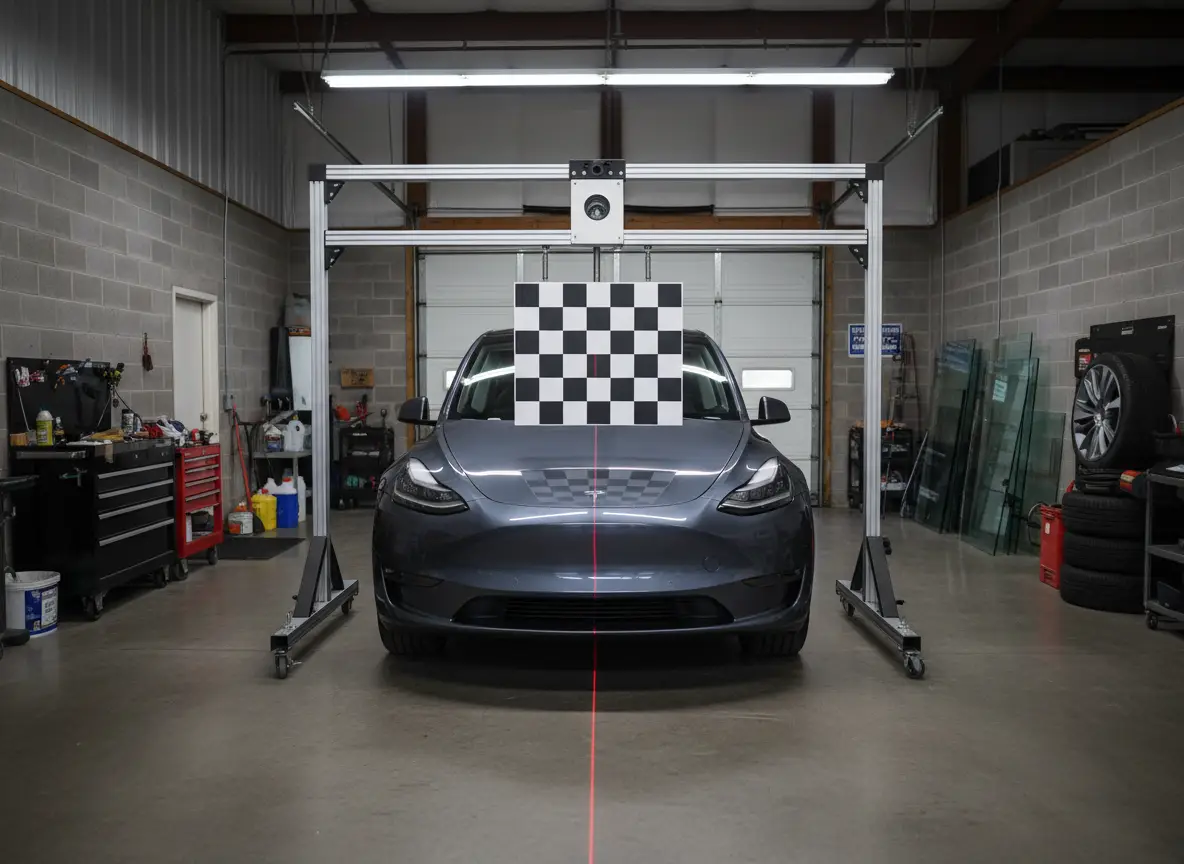
If your car was built in the last several years, there's a decent chance a small camera sits behind the windshield, up near the rearview mirror. You've probably never thought about it. It watches the road ahead and feeds information to features like lane departure warning and automatic braking. When we replace your windshield, that camera gets unbolted and put back, and its view of the road is no longer guaranteed to match what the car expects. That's what recalibration fixes.
What's actually behind the glass
ADAS stands for advanced driver assistance systems. The windshield is the mounting point for the cameras that run many of them. Depending on the vehicle, that can include lane departure warning, forward collision sensors, adaptive cruise control, traffic sign recognition and automatic braking. Backup and parking cameras show you a picture too, and their angles need to be accurate for the same reason.
Those systems don't think the way you do. A camera that's tilted even a little can read the lane line as being somewhere it isn't, or judge the car ahead as closer or farther than it really is. The car trusts the picture it's handed.
Why a new windshield changes the view
No two pieces of glass sit in a frame in exactly the same spot. A new windshield has its own slight curve, its own bracket position, and a fresh bead of urethane under it. The camera mounts to the glass, so a change of a fraction of a degree in the bracket changes where the camera is pointing. Out on the highway, that small angle gets magnified, because the camera is looking a long way down the road.
That's why we treat recalibration as part of a windshield job on any car with a forward camera instead of an optional extra. We do the recalibration after every windshield replacement, and it's done in our own shop.
What recalibration involves
First, the windshield is replaced or inspected, and we make sure the camera is mounted correctly. Then comes the calibration itself. The car is set up in the bay facing a target, positioned to the carmaker's specifications, and the scan tool walks the camera through its alignment routine. Newer equipment and the right setup matter here, because the target distances and floor measurements are exact, not approximate.
The last step is verification. We confirm the system reports as ready, and the camera is doing its job, so the car leaves the shop road-ready. Some vehicles also want a short drive as part of the routine. We'll tell you if yours does.
What skipping it can look like
A camera that's off doesn't always throw a warning light. More often the car just behaves oddly. The lane assist tugs the wheel when you're perfectly centered, or doesn't react when you drift. A collision warning chirps for a car that's far ahead, or stays quiet when it shouldn't. Adaptive cruise holds a gap that feels wrong. Any of that after a glass job is a good reason to call us instead of just living with it.
We wouldn't want to drive a car whose safety systems hadn't been checked after the camera was moved, and we don't think our customers should either. What your insurer or your owner's manual says about it is a separate question, and the answer depends on your policy and your vehicle.
Other times a camera needs attention
A windshield isn't the only reason to recalibrate. Calibration is also called for after a camera is removed or replaced, after a front-end collision, after suspension or alignment work that changes the car's ride height or angle, after an airbag deployment, or after any repair that touches the camera's position. If you've had work like that done somewhere else and the lane assist hasn't felt right since, we can look at it.
Our shop's own line on this is simple: don't worry about going to the dealership for your ADAS recalibration, because we offer that service in our shop so you can save time and money. The glass and the recalibration happen in the same place, with one scheduling call, and nobody has to shuttle your car across Butte County.
Book it with the glass
If your car has lane departure warning, adaptive cruise or automatic braking, mention it when you call so we can plan the recalibration into the visit. Not sure what your car has? Give us the year, make and model and we'll tell you. Call A Touch of Glass & Screen at (530) 538-8100, or stop by the shop on South 5th Avenue in Oroville, Monday through Friday from 8 to 5 and Saturday from 9 to 1.
A Touch of Glass & Screen, (530) 538-8100
Call (530) 538-8100More articles
Chip or Crack: When a Windshield Can Be Repaired and When It Can't
Size, location and timing decide whether your windshield damage is a short repair or a full replacement.
Using Insurance for Auto Glass: How a Glass Claim Usually Goes
A glass claim is usually simpler than people expect, especially when the shop you call knows the process.